
Before you choose
Look beneath the curl outline
This gallery focuses on the side and back beneath curly tops. Compare how much shading remains, how high the close area rises and how the nape connects to the curls. The photographs show finished appearances, not proof of a natural curl pattern or a particular chemical process. Decorative lines and parts are optional details rather than requirements of a curly fade.
The hairstyle gallery
20 curly hair fade ideas to compare
Compare the visible length, shape, texture, and finish before choosing a salon reference.
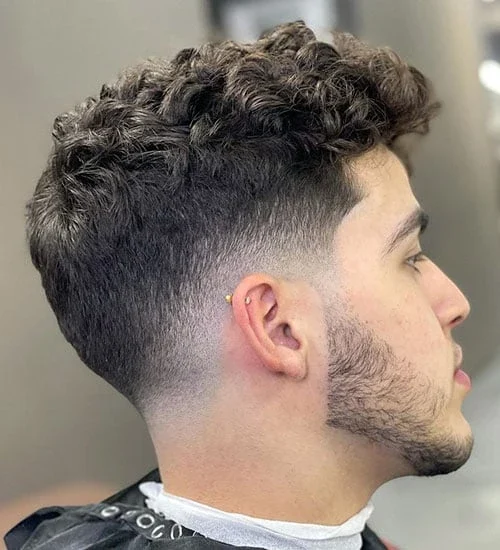
Idea 01
Short Curls With a Shaded Rear Blend
Short curls remain full above a softly shaded side transition. The rear connection retains darker hair instead of exposing the entire lower back at one height.
- Shape
- Short upper curls
- Detail
- Shaded rear transition
The side-rear view makes the change in length around the ear visible. The upper curls stay compact, with no long fringe hanging across the face from this angle.
Wearability note: Choose the darker rear coverage if you prefer a softer connection beneath the curls. Pair this with a front reference for fringe length, because the back angle cannot show how far you want the front pieces to fall.
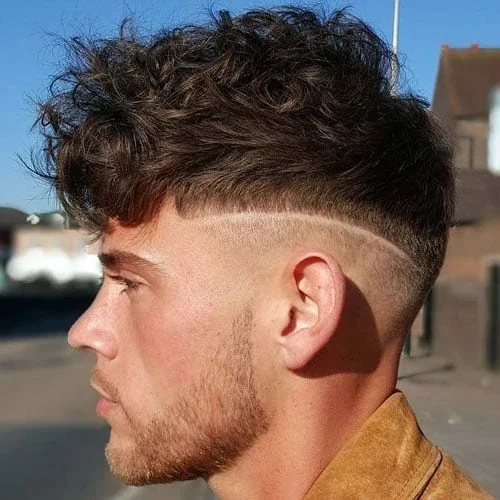
Idea 02
Curly Top With a Long Curved Side Line
A long pale arc runs beneath the loose curly top. The side below it is closely exposed, creating a stronger division than the softly shaded examples.
- Shape
- Loose curly top
- Detail
- Long pale side arc
The upper curls form a broad irregular outline, while the front edge stays relatively short. The shaved line follows the side boundary but is a decorative addition rather than the curl shape itself.
Wearability note: Decide whether you want the arc before choosing this reference. A plain fade can keep the same upper width, and removing the line would make the transition look quieter without changing the retained curls.
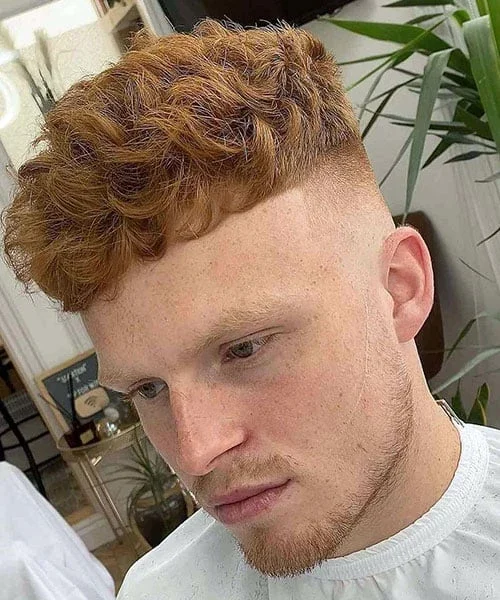
Idea 03
Ginger Curls With High Side Exposure
Ginger curls bend forward above a high close side. The exposed lower area makes the retained top appear more separate, even though the upper shape is not especially tall.
- Shape
- Ginger forward curls
- Detail
- High side exposure
The front curls overlap in several larger bends. The side is closely contained beneath them, leaving the texture concentrated along the top rather than continuing at equal width around the head.
Wearability note: Compare the side height before copying the fringe. A lower transition could retain more coverage while keeping similar forward curls, so placement and front length should be discussed as separate decisions.
Choose your direction
Compare side contrast
Look at soft retained shading beside more exposed close finishes.
Choose curl width
Compare compact tops with broader upper silhouettes and longer fringes.
Check the nape
Decide how much back length should remain below the crown.
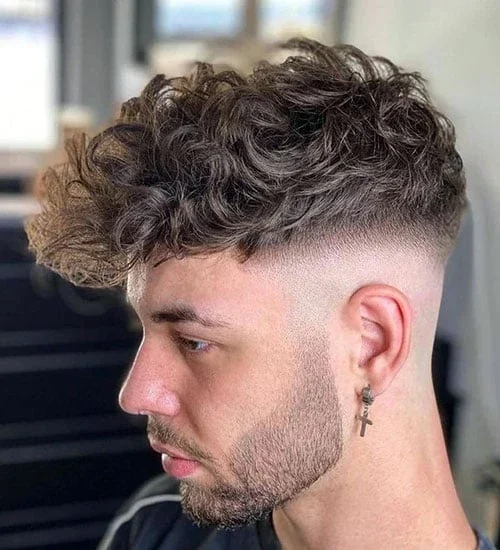
Idea 04
Loose Brown Curls With a Pale Lower Side
Loose raised curls create a fuller upper shape above a pale side. The lower transition removes width around the ear while leaving a darker band beneath the curls.
- Shape
- Loose raised curls
- Detail
- Pale lower transition
The front bends slightly forward, and the top has small spaces between the larger curls. The beard adds a separate darker outline below the cheek.
Wearability note: Choose how much darker side coverage you want under the curls. A wider shaded band would connect the upper shape more softly, while a narrower band would make the retained texture appear more detached.
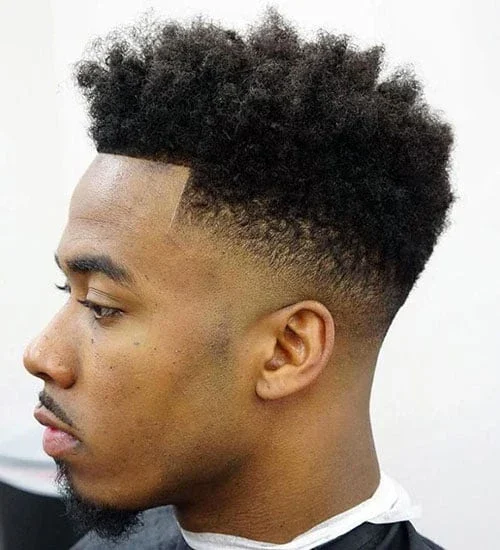
Idea 05
Full Coils Above a Soft Low Blend
Full coils remain broad above a soft lower-side blend. More hair stays along the upper side than in the highly exposed versions, keeping the outline relatively connected.
- Shape
- Full upper coils
- Detail
- Soft lower-side blend
The squared front corner contrasts with the irregular coiled ends. Near the ear, the hair becomes shorter gradually rather than meeting a prominent shaved design.
Wearability note: This is useful if you like visible texture without a large bare side panel. Compare the upper width with the closer faded examples, because retained side coverage contributes substantially to the fuller silhouette.
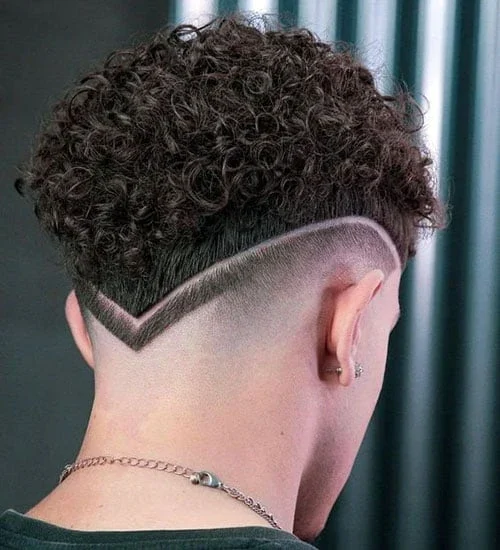
Idea 06
Rounded Curls With a Rear V Accent
A pale V-shaped accent draws attention to the close nape beneath the rounded curls. The rear view shows how much upper fullness remains above the shorter lower section.
- Shape
- Rounded upper curls
- Detail
- Rear V-shaped accent
The curls form a broad cap rather than a narrow ridge. The shaded transition follows the back of the head, while the decorative V sits lower within that close area.
Wearability note: Use this for rear coverage and decide separately whether you want the V. The rounded top can stay the same above a plain nape, so the design should not distract from the amount of length you want retained.
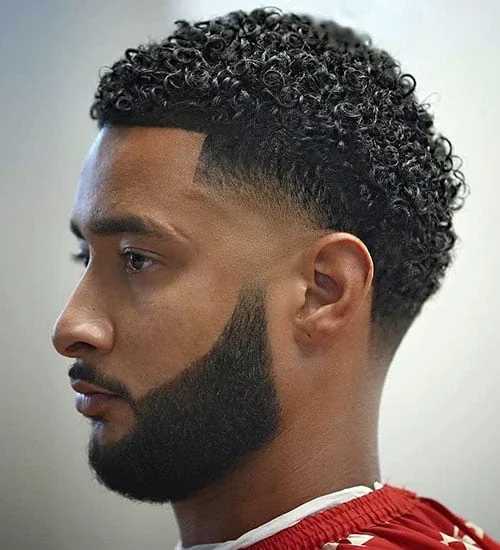
Idea 07
Small Defined Curls With a Rounded Back
Small defined curls form a rounded top and back. The closer side reduces width around the ear while the rear remains visibly fuller.
- Shape
- Small defined curls
- Detail
- Rounded retained back
The front edge is squared, giving the upper curls a clear boundary at the temple. The beard stays full below, making the lighter side opening easier to distinguish from the facial-hair outline.
Wearability note: Compare the rounded rear with a shorter nape before deciding. The side fade can be similar in both versions, but retaining more curl length behind the ear changes the profile.
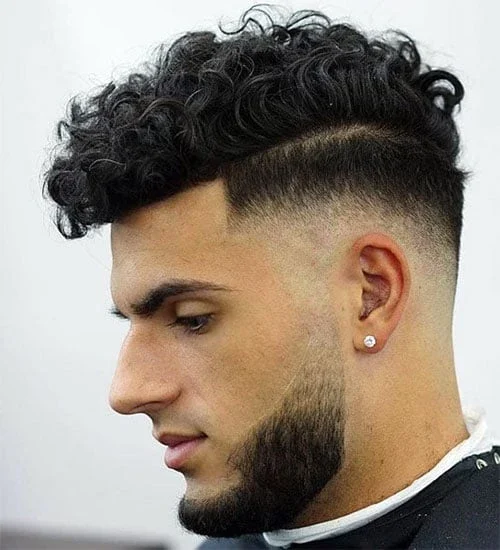
Idea 08
Curly Front With a Defined Side Part
A defined side part gives the curly front a clear direction. The side below it is closely faded, separating the retained upper curls from the lower outline.
- Shape
- Curly forward front
- Detail
- Defined side part
The front curls rise and turn forward rather than lying in straight combed ridges. The darker side strip remains visible beneath the part before the hair becomes shorter around the ear.
Wearability note: Choose the part width independently of the curl length. A less pronounced division could retain the same front shape, while a longer fringe would change forehead coverage without necessarily changing the fade.
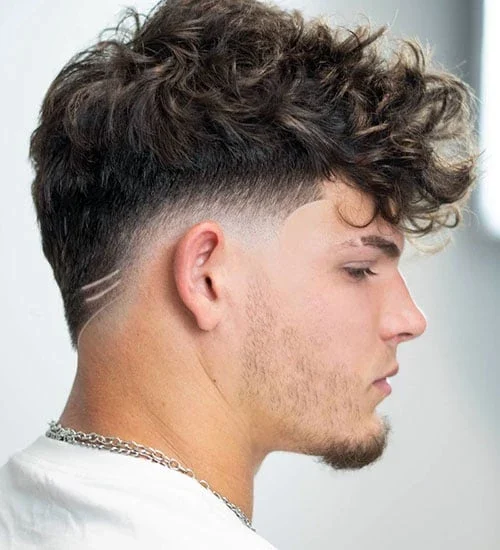
Idea 09
Loose Fringe With Two Small Rear Lines
Loose curls fall toward the forehead while two small pale lines sit behind the ear. The fade itself stays close beneath a darker upper-side section.
- Shape
- Loose curly fringe
- Detail
- Paired rear-side marks
The profile shows more front length than rear extension. The decorative marks are concentrated low on the rear side, leaving the upper curl shape relatively uninterrupted.
Wearability note: Use the profile for fringe reach and the lower transition. The small lines are optional, and a plain version can preserve the same forward curls without repeating the decorative detail.
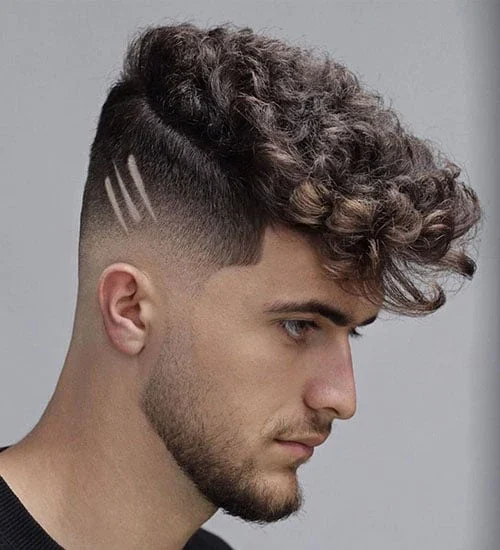
Idea 10
Long Front Curls With Three Side Strokes
Longer curls gather at the front above a close side. Three pale strokes add a small pattern near the upper fade boundary.
- Shape
- Longer front curls
- Detail
- Three shaved side strokes
The front curls extend farther than the hair behind them, creating an uneven forward outline. The side remains narrow around the ear, so the longer fringe is the dominant feature.
Wearability note: Choose the front length first if that is what attracts you. The shaved strokes can be omitted, and a shorter fringe would make the same side fade appear more compact overall.
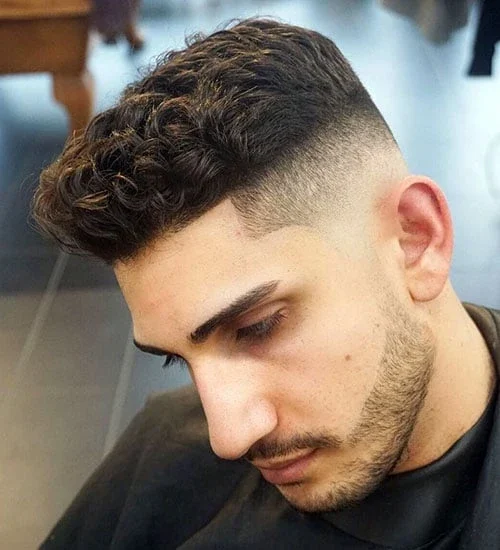
Idea 11
Compact Curls With a Crisp Temple
Compact curls keep the upper shape relatively low. A crisp temple edge defines the front corner where the curls meet the closely faded side.
- Shape
- Compact upper curls
- Detail
- Crisp temple edge
The top has visible small bends without a long hanging fringe. The lower side is much lighter, while the beard creates a separate narrow outline along the jaw.
Wearability note: Compare this with the larger curled fringes if you want less top volume. Ask about the corner shape separately, since softening that edge would change the front impression without requiring longer curls.
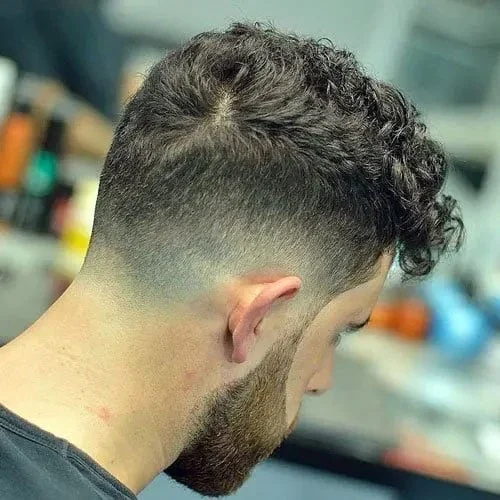
Idea 12
Short Curls With a Close Rear Nape
The rear nape is closely cut beneath the short curls. This angle makes the transition in coverage clear without relying on the front fringe or a decorative line.
- Shape
- Short upper curls
- Detail
- Close rear nape
The curl texture remains mostly along the upper head, with darker hair tapering toward the back. The lowered head reveals the crown but changes the apparent height of the top.
Wearability note: Save the rear angle to explain how much nape you want exposed. Pair it with a level profile for upper height, rather than treating the tilted view as a complete measurement of the cut.
Idea 13
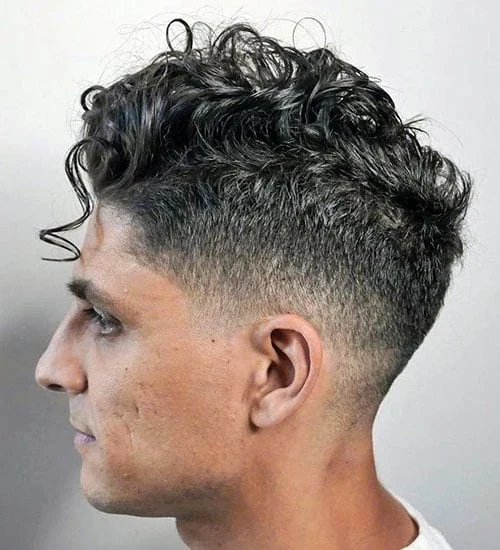
Loose Curls With a Broad Shaded Side
Loose curls sit above a broad shaded side. One front curl hangs farther forward, making the fringe less uniform than the compact cropped examples.
- Shape
- Loose upper curls
- Detail
- Broad shaded side
The transition retains visible hair around the upper ear area rather than creating an almost bare panel. The upper curls remain full while the lower outline is gradually shortened.
Wearability note: Choose this if you prefer a softer connection beneath the texture. The single forward piece is part of one finished arrangement, so discuss the overall fringe length rather than expecting that exact curl to sit in the same place.
Idea 14
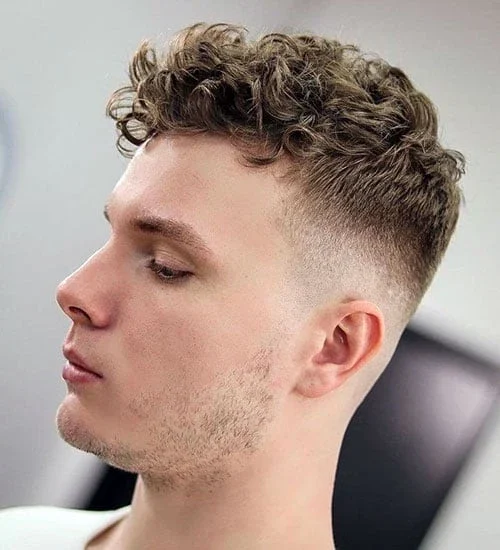
Short Brown Curls With a Gentle Side Blend
Short rounded curls keep the front compact above a gentle side blend. The transition is less stark than the versions with a narrow dark band and broad exposed skin.
- Shape
- Short rounded curls
- Detail
- Gentle side blend
The upper bends remain visible without much extra crown height. The side portrait shows the ear area closely contained while retaining a softer connection toward the upper section.
Wearability note: This reference suits a comparison of lower contrast rather than dramatic separation. Point out how much shading you want retained, because the curl length alone does not explain the softer appearance of the side.
Idea 15
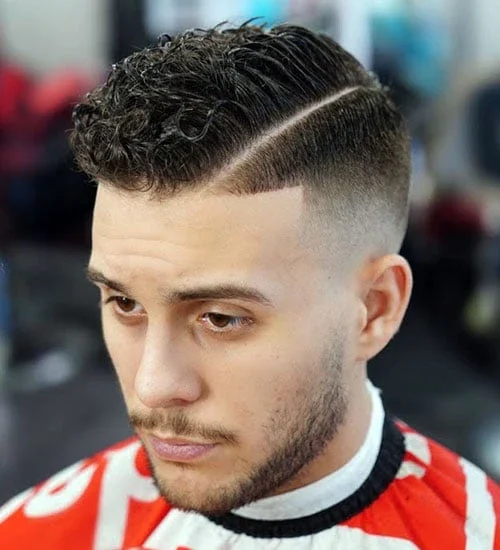
Small Curled Front With a Fine Part
Small curls collect at the front beside a fine side division. The hair behind them follows a smoother direction, giving the upper section a more organized shape.
- Shape
- Small curled front
- Detail
- Fine side division
The closely faded side creates contrast beneath the part. The temple edge is squared, while the short front curls add a softer surface above that firm corner.
Wearability note: Compare this with the unparted curled tops if you want more direction. The visible division and fade can be chosen separately from the amount of curl retained at the front.
Idea 16
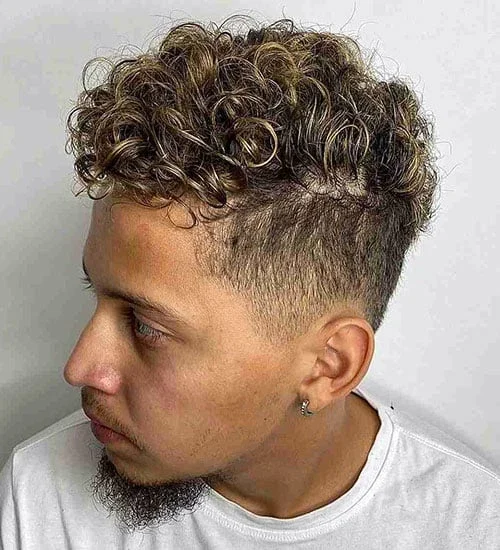
Highlighted Curls With Retained Side Shading
Highlighted curls separate clearly above a side that retains visible shading. The lower edge is close, but the upper texture does not sit over a large bare panel.
- Shape
- Highlighted separated curls
- Detail
- Retained side shading
The light tips trace several individual curl bends. The front remains raised rather than hanging low, and the darker side helps connect that volume to the back.
Wearability note: Choose the retained coverage if you prefer a gentler contrast. The highlights make curl separation more noticeable, but the amount of side hair is an independent decision that would matter in any color.
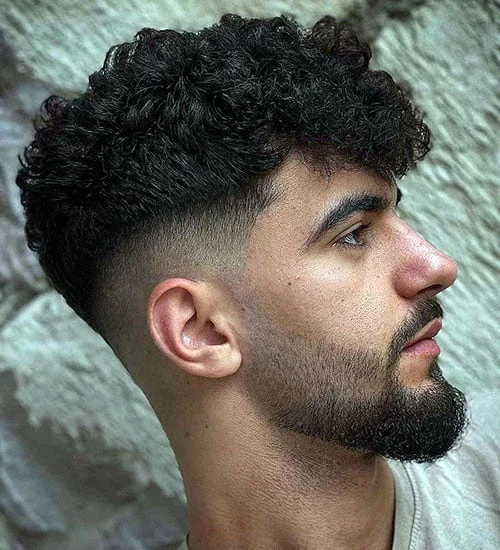
Idea 17
Broad Dark Curls With a Close Temple
Broad curls keep the upper silhouette full while the temple becomes closely cut. The retained upper hair extends beyond the narrower side without a long straight overhang.
- Shape
- Broad upper curls
- Detail
- Close temple transition
The front curls rise and bend in several directions. The side portrait also shows the beard beginning below the fade, keeping the upper texture and lower facial-hair shape distinct.
Wearability note: Use this to compare upper width with side clearance. A smaller top could sit above the same transition, so identify whether you want the broad curl silhouette or mainly the close temple finish.
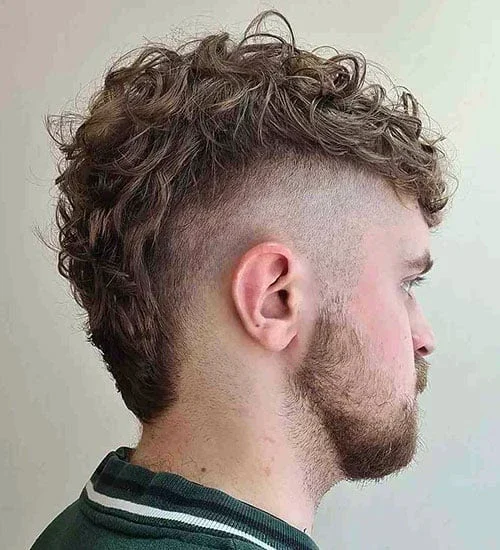
Idea 18
Curly Ridge With a Longer Back
The curly ridge continues into a longer rear section. The closely cut side exposes the area beside the ear, emphasizing the contrast with that retained back.
- Shape
- Curly upper ridge
- Detail
- Longer retained rear
The profile shows loose curls along the top and more length below the crown. The fade curves around the shorter side instead of removing the rear at an even height.
Wearability note: Choose the extended back deliberately. It is an additional length decision, and a shorter nape could keep a similar curly top while producing a more compact profile.
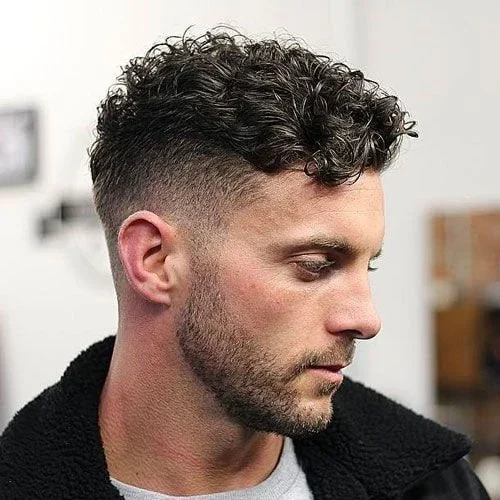
Idea 19
Short Curled Front With Soft Side Shading
The short curled front adds texture without a tall ridge. Soft side shading narrows the outline while keeping the upper hair visibly connected.
- Shape
- Short curled front
- Detail
- Soft shaded sides
Several small bends sit near the forehead, with the rest of the top staying compact. The lower side is shorter around the ear, but the transition is not marked by a shaved line.
Wearability note: Compare the softer side with a more exposed example before choosing. This version is useful when you want the curls to remain the main feature and the fade to act as a quieter supporting shape.
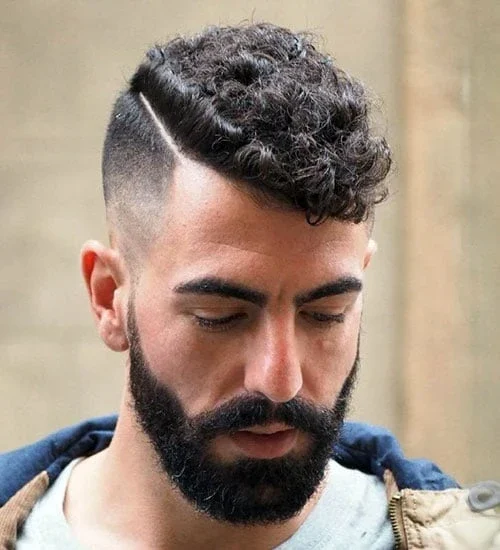
Idea 20
Side-Part Curls With a Full Beard
A defined side division directs the curls across the upper head. The closer side creates contrast underneath, while the fuller beard adds substantial volume below the jaw.
- Shape
- Directed upper curls
- Detail
- Defined side division
The front curls remain separated and slightly raised rather than forming one smooth ridge. The downward angle shows the part clearly but reveals less of the lower nape.
Wearability note: Choose the part direction and curl length before considering the beard in the portrait. A different beard would change the overall balance, while a rear photo would still be needed to specify the back of the fade.
Explain the blend without copying every accent
A shaved arc or a defined part can draw attention away from the underlying transition. Compare a plain example too so the chosen side exposure remains clear without the decoration.
Keep the front and rear references together when possible. A longer curly fringe does not establish how much nape should be exposed, and a close rear view does not specify the curl length above the forehead.

About the author
Bella Ross
Bella Ross is the hairstyle editor behind Latest Easy Hairstyles. She curates practical haircut, braid, color, and styling ideas with a focus on looks that are easy to browse, realistic to recreate, and useful for everyday hair decisions.